


07
2026
-
05
How to Match SS10 Carbide Grades with Real-World Quarry Conditions: A Practical Guide
In the stone quarrying industries of Kenya and Libya, SS10 carbide tips are effectively the "teeth" of the industry. For B2B wholesalers and large-scale quarry operators, selecting the right grade is not just about hardness—it is a strategic decision to balance operational stability, cutting efficiency, and total cost of ownership.
This guide analyzes how to scientifically match SS10 carbide grades to specific geological conditions to ensure maximum productivity.
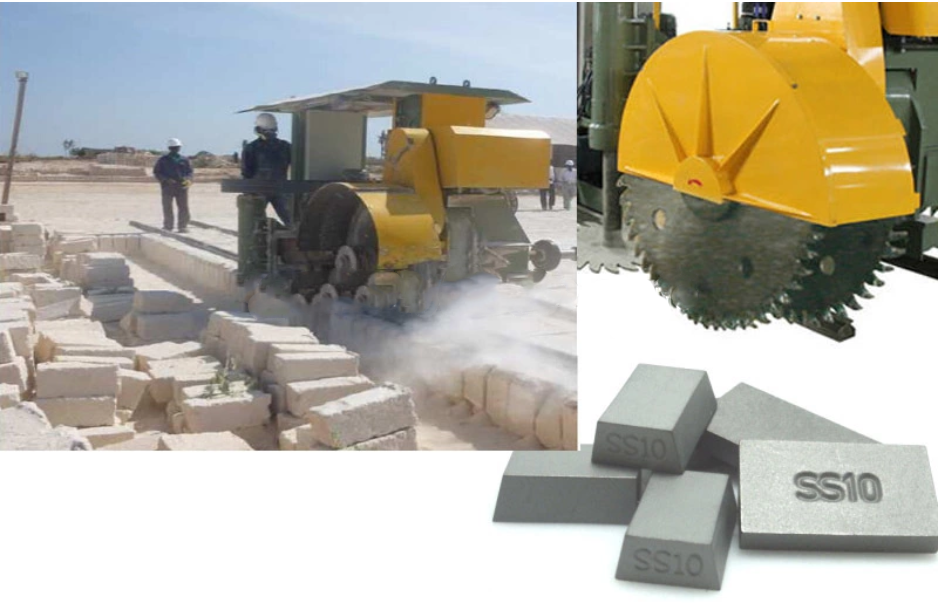
The Core Performance Balance: Hardness vs. Toughness
The performance of any SS10 tip is determined by its internal microstructure. In real-world quarrying, we must manage a critical "seesaw" between two parameters:
Hardness (Wear Resistance): Determines how many meters the tip can cut before becoming dull.
Impact Toughness (TRS): Determines whether the tip can withstand hitting a crack or a hard inclusion without shattering.
Expert Insight: For high-volume B2B orders, quality is defined by consistency. It is not just about the material label, but the refinement process and sintering technology that ensure every tip in a 10,000-unit batch performs identically.
2. Grade Selection Strategies for Specific Site Conditions
Scenario A: Homogeneous Limestone & Coral Stone (High-Efficiency Zones)
In stable quarries with consistent stone density and minimal machine vibration, the primary enemy is friction-wear.
Recommended Grades: YG8 / YG11
Technical Profile: High Hardness (HRA 89.0–90.5).
Best For: Clients who prioritize cutting speed and long intervals between sharpening. These grades excel in "clean" soft-to-medium stone.
Scenario B: Fractured Rock & Mixed Layers (The "Stability-First" Zone)
Common in many African quarries where the rock has natural fissures or uneven hard spots that cause machine "jumping."
Recommended Grade: YG11C (Coarse-Grain Grade)
Technical Profile: Specifically engineered with a coarse-grain structure to achieve high Transverse Rupture Strength (TRS 2800 MPa).
Best For: This is the "All-Terrain" choice for the African market. The coarse-grain structure acts as a shock absorber, stopping cracks from spreading. For wholesalers, this is the safest choice with the lowest rate of customer complaints.
Scenario C: Abrasive Sandstone & Heavy-Duty Operations (Maximum Durability)
For silica-rich stone or hard formations where dry cutting creates extreme thermal and mechanical stress.
Recommended Grades: YG13C / YG15
Technical Profile: Exceptional impact resistance and thermal stability.
Best For: Extreme environments where preventing "total tip failure" is more important than pure cutting speed.
3. Beyond the Label: Why "Process Control" is the Real Quality Driver
In large-scale trade, buyers fear "performance fluctuation" between batches. To ensure SS10 tips provide reliable ROI, we focus on advanced manufacturing milestones rather than just raw material labels:
Sinter-HIP (Overpressure Sintering) Technology:
Traditional sintering can leave micro-pores inside the carbide. We utilize 10MPa Sinter-HIP technology, which applies high pressure during the liquid phase of sintering. This eliminates internal voids, drastically increasing the density and fatigue resistance of the tips.
Grain Homogenization:
Our refining process ensures that tungsten carbide grains are distributed uniformly. A homogeneous microstructure means the tip wears down smoothly rather than losing chunks of material during a cut.
Automated Precision Forming:
For B2B buyers who weld these tips onto saws, dimensional consistency is vital. Our automated pressing ensures every SS10 tip fits perfectly into standard holders, reducing welding labor costs and rejection rates.
4. A Buyer’s Checklist for SS10 Procurement
When evaluating a supplier for the Kenya or Libya markets, focus on these three pillars:
Batch-to-Batch Consistency: Ask for the variance range of Hardness and TRS. Consistency is what protects your reputation as a reseller.
Application-Specific Advice: Avoid "one-size-fits-all" suppliers. A professional partner should recommend a grade based on your specific rock samples.
Supply Chain Reliability: SS10 is a high-volume commodity. Monthly capacity and lead-time stability are as important as the technical specs.
Conclusion
Choosing the right SS10 carbide tip is an art of balance. By focusing on advanced Sinter-HIP processing and matching the grain structure to the geological reality of the quarry, you can significantly reduce downtime and increase output.
Get a Technical Consultation & Quote
Are you looking for the most cost-effective SS10 solution for your market?
Our technical team can help you analyze your local rock conditions and provide a customized grade recommendation.
Contact us today for bulk pricing and technical data sheets.
RELATED NEWS

Zhuzhou Chuangde Cemented Carbide Co., Ltd
Add215, building 1, International Students Pioneer Park, Taishan Road, Tianyuan District, Zhuzhou City
SEND US MAIL
COPYRIGHT :Zhuzhou Chuangde Cemented Carbide Co., Ltd
Sitemap
XML
Privacy policy